.svg)


.png)
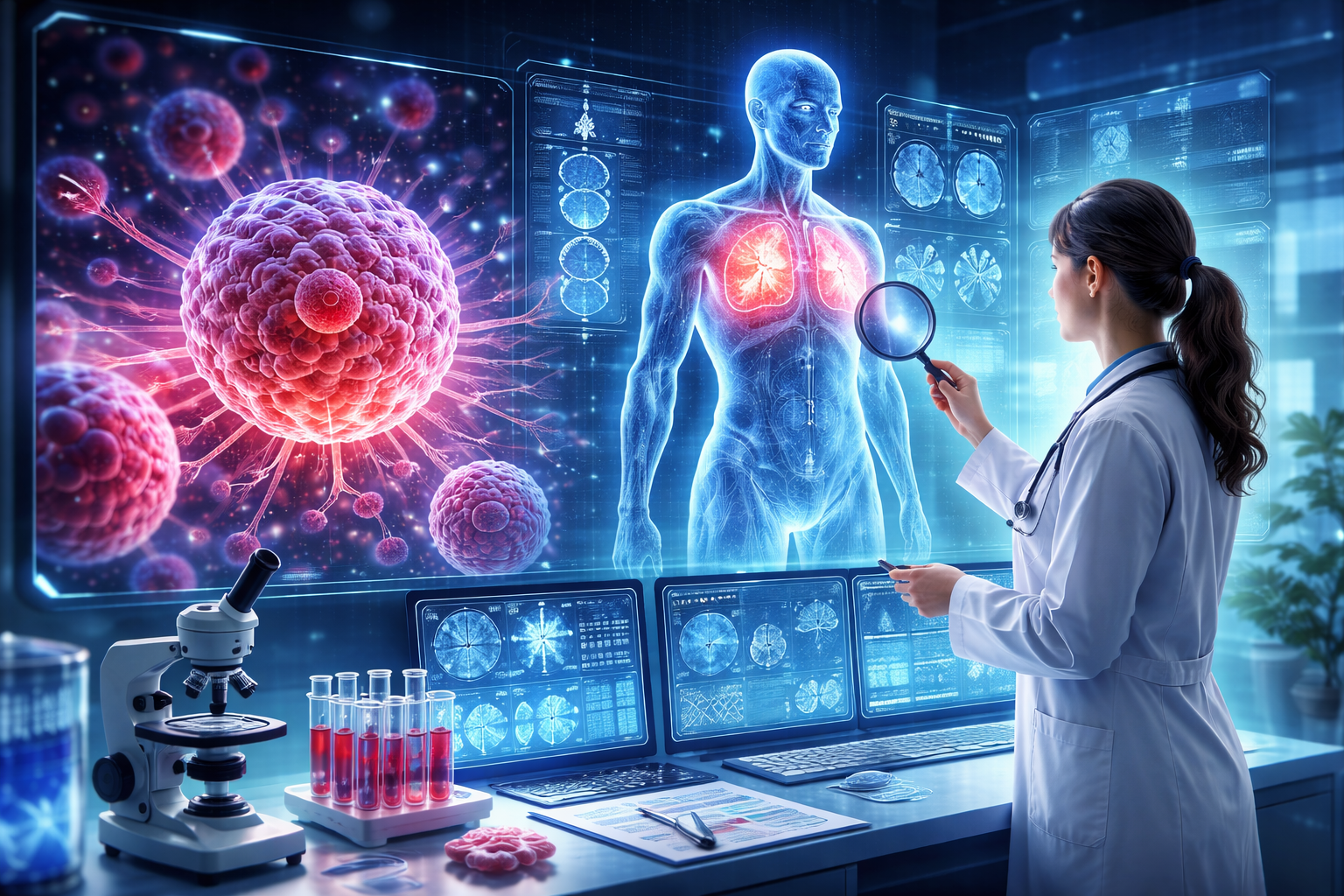
How AI is Transforming Cancer Screening and Improving Patient Outcomes
Key Takeaway: Recent clinical trials demonstrate that AI-powered cancer detection systems can identify malignancies up to 2 years earlier than traditional methods, with sensitivity rates exceeding 94% across multiple cancer types.
For Physicians: Multiple AI cancer detection systems have received FDA clearance and CE marking for clinical use, offering significant improvements in early detection rates while reducing false positives.
Evidence Level: Multiple peer-reviewed studies from 2024-2025, including large-scale trials with over 100,000 patients, confirm AI's clinical efficacy in real-world settings.
The Early Detection Imperative
Every oncologist knows the stark reality: early detection remains the single most powerful predictor of cancer survival. A Stage I diagnosis can mean a 90% five-year survival rate, while Stage IV drops that number below 30% for many cancers.
The Problem: Despite advances in screening technology, approximately 40% of cancers are still diagnosed at advanced stages. Radiologists review thousands of images annually, and subtle early-stage markers often go undetected in the overwhelming volume of data. Diagnostic errors contribute to delayed cancer detection in 15-20% of cases.
Breakthrough Performance Across Multiple Cancer Types
The past two years have produced remarkable clinical validation of AI cancer detection systems. A 2025 Nature Medicine study involving 463,094 women across 12 sites in Germany demonstrated that AI-supported mammography screening achieved a 17.6% higher breast cancer detection rate compared to standard double reading. The AI system detected 20% more cancers than radiologists alone, while reducing false-positive recalls. AI algorithms have demonstrated the ability to identify individuals at elevated cancer risk years before traditional diagnosis.
Key Insight for Physicians: AI cancer detection tools function as a highly sophisticated second reader, flagging suspicious findings for physician review rather than replacing clinical judgment.
Clinical Applications - Where AI Makes the Greatest Impact
Breast Cancer Screening
Meta-analysis showed pooled sensitivity of 94.6% for AI-based lung cancer screening. Radiologists using AI assistance complete reviews 23% faster while achieving higher accuracy. The technology particularly excels in dense breast tissue, where traditional mammography faces limitations.
Implementation Benefits:
- Diagnostic Accuracy: 13-20% increase in early-stage cancer detection
- Time Efficiency: Average reading time reduced from 64 to 44 seconds per case
- Patient Outcomes: Earlier detection correlates with 30% improvement in five-year survival rates
Lung Cancer Screening
AI systems for lung cancer screening have demonstrated pooled sensitivity of 94.6% in detecting lung cancer, with specificity of 93.6%. Studies show AI models achieve sensitivity ranges of 86-98% for lung nodule detection, significantly outperforming radiologists' 68-76% sensitivity in certain applications. AI's volumetric analysis also provides precise calculations of nodule growth rates, detecting subtle changes that inform earlier intervention decisions.
Colorectal Cancer Detection
Real-time AI assistance during colonoscopy has shown 20-26% improvement in adenoma detection rates. The technology addresses "perceptual miss rate," in which polyps are within the visual field but go unrecognized. AI systems highlight suspicious areas in real-time, prompting immediate examination and potential polypectomy.
Latest Research Trends (2024-2025)
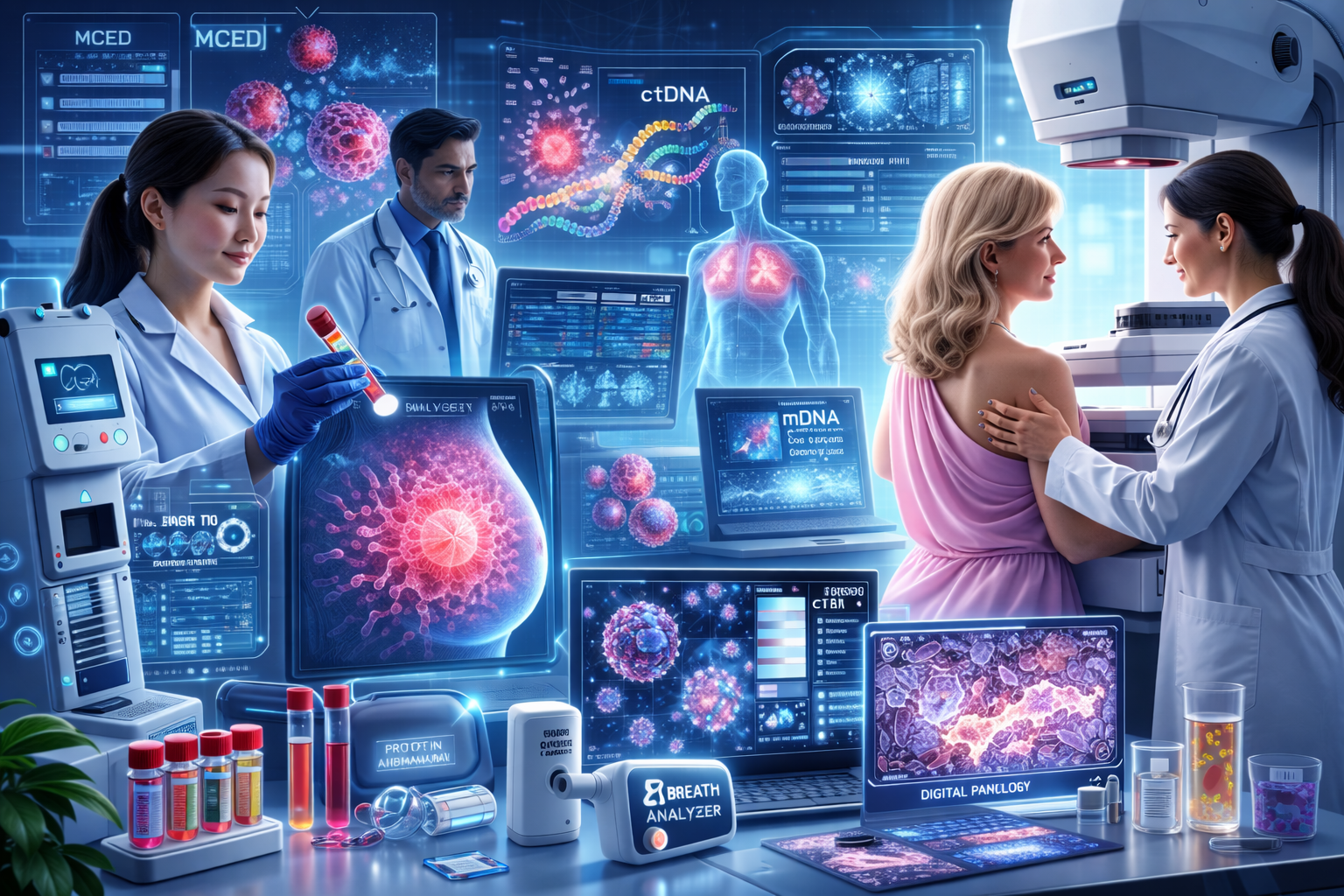
Multi-Modal AI Integration: Combining imaging data with electronic health records, genetic markers, and lab values improves predictive accuracy by 15-18% over imaging alone. Research published in Nature Medicine demonstrated that AI algorithms can identify individuals at highest risk for pancreatic cancer up to three years before diagnosis using medical records alone.
Pancreatic Cancer Early Detection: A nationwide Taiwan study published in Radiology demonstrated that a deep learning tool achieved 92.8% specificity and 89.7% sensitivity in detecting pancreatic cancer on CT scans. The PANDA model, published in Nature Medicine, achieved 92.9% sensitivity for pancreatic lesion detection using non-contrast CT. Research has shown AI models can identify pancreatic cancer risk up to three years before traditional diagnosis.
Liquid Biopsy Enhancement: AI analysis of circulating tumor DNA patterns shows promise for ultra-early detection. Early results suggest that AI can identify cancer signatures in blood samples 12-18 months before conventional imaging.
Practical Takeaways for Physicians
Action Steps:
- Immediate: Review FDA-cleared AI cancer detection tools for your specialty with robust clinical validation. Evaluate integration with existing PACS - most platforms connect seamlessly without requiring new hardware
- Short-term: Establish protocols for AI-flagged findings, including triage criteria and follow-up pathways. Train staff on AI-assisted interpretation for optimal utilization.
- Long-term: Monitor performance metrics comparing AI-assisted detection rates against historical baselines
The Future of Early Cancer Detection
AI-powered cancer detection represents one of medicine's most significant advances in early diagnosis. The evidence is clear: AI systems now detect cancers earlier, more accurately, and more efficiently than traditional screening protocols alone. As AI continues to evolve, tools like bioscope.ai empower physicians to save more lives through earlier intervention while optimizing diagnostic workflows.
Next Steps: Schedule a demonstration to see how bioscope.ai can enhance your cancer screening workflows and improve early detection rates in your practice.